


Intelligent Resource Planning Explained: Insights from a Consultant and a Data Scientist
No matter the industry, one thing is true: planning ahead is getting harder. Hospitals face sudden patient surges, airlines juggle complex schedules, and many businesses struggle to keep things running smoothly when plans change at the last minute.
For those reasons, more and more organizations are turning to Intelligent Resource Planning (IRP). Simply put, IRP uses past data, real-time updates, and smart predictions to help teams prepare better. Instead of guessing what might happen next, they can plan with more accuracy and flexibility.
In this blog, we speak with Katrin, an experienced consultant who helps organizations put IRP into practice, and Martijn, a data scientist, the guy behind the scene, who builds the predictive tools that make it work. Together, they explain how IRP solves real-world problems, why it’s becoming essential, and how any organization, big or small, can get started.
Q: In simple terms, what is Intelligent Resource Planning (IRP), and why is data-driven, predictive planning becoming a necessity across industries today?
Katrin: Intelligent Resource Planning (IRP) is a modern approach to planning that combines historical data, real-time inputs, and predictive models to make better decisions about resource allocation, whether it’s staff, equipment, rooms, or time. It enables organizations to understand what they’ll need next, not just what they needed yesterday. It’s becoming essential across industries because today’s environments are fast-moving, unpredictable, and highly interdependent. Static plans fall short when demand changes hourly, teams are overstretched, and systems don’t talk to each other. That’s why IRP is less about improving a spreadsheet, and more about helping organizations plan with confidence, even in uncertainty.
Martijn: Yes, I agree with Katrin. In healthcare, for example, it starts with flow prediction: forecasting how many patients will arrive and when. From there, it moves to throughput optimization, making sure patients move smoothly through the hospital, from admission to discharge. Finally, it scales up to hospital-wide resource planning, aligning staff, beds, equipment, and even operating rooms across departments. This step-by-step approach makes the whole system more agile, efficient, and resilient. Something every industry needs today in a world full of rapid changes and unexpected challenges.
Q: Which industries stand to benefit the most from Intelligent Resource Planning and can you give an example of the specific challenge they face that IRP can address?
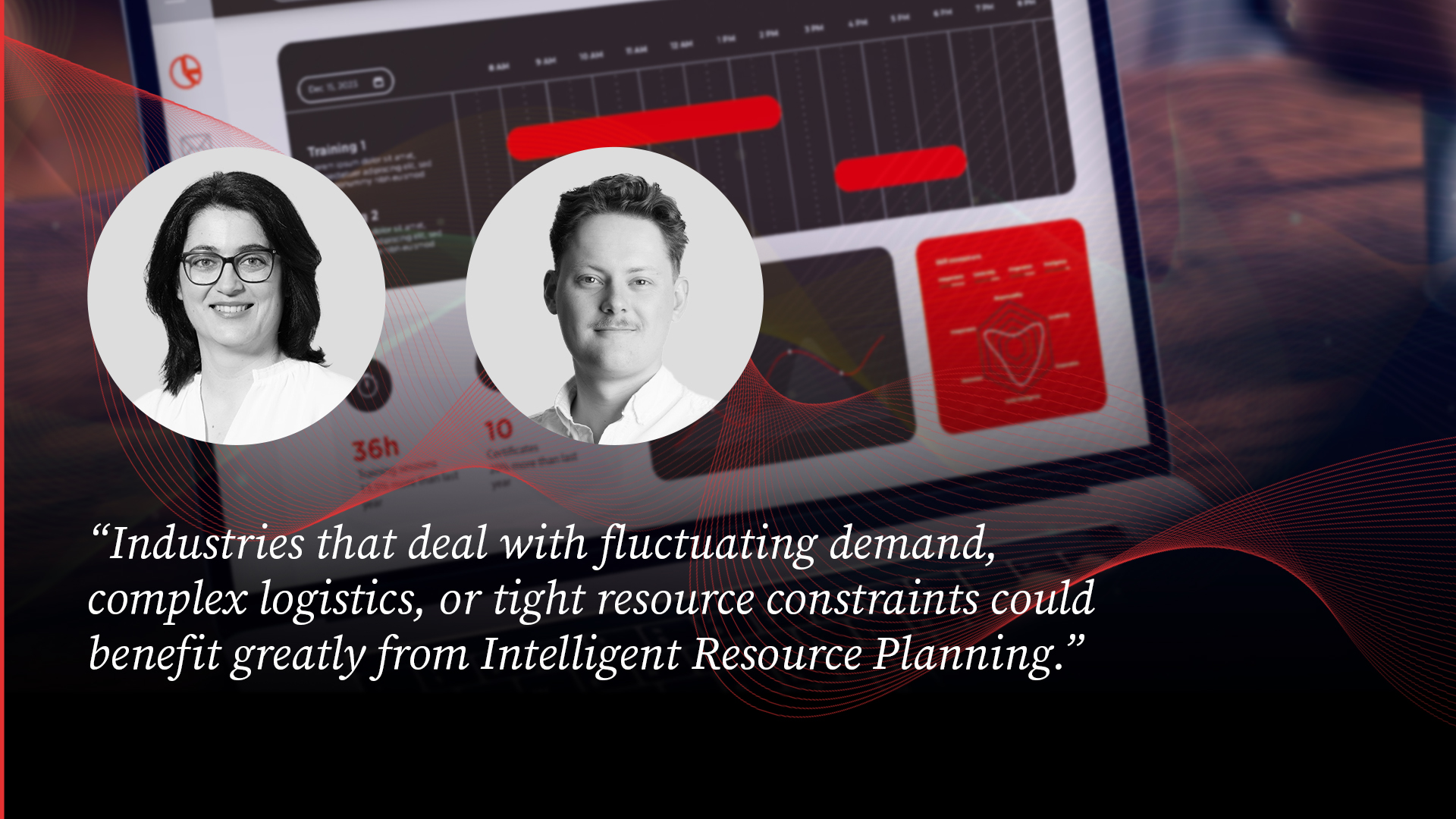
Industries that deal with fluctuating demand, complex logistics, or tight resource constraints could benefit greatly from IRP.
Katrin: Intelligent Resource Planning isn’t a one-industry wonder, but if we had to name a few early adopters, healthcare would top the list. When you’re trying to align staff availability with unpredictable patient flows and limited ICU beds, real-time, data-driven planning becomes a necessity, not a nice-to-have.
The aviation industry faces a different kind of complexity. For one Dutch airline, our team developed an optimization model to plan career paths for thousands of pilots. The system had to account for hiring, training, regulations, and even retirements – all while simulating different market scenarios. The result? Long-term plans that reduce staffing gaps and save costs, without compromising compliance. Whether in hospitals or cockpits, IRP enables organizations to move from reactive firefighting to confident, data-driven decisions.
Q: Martijn, as a Data Scientist who worked in many IRP projects, what is in your opinion the role AI plays in IRP, and how does it enable more resilient, agile operations across different domains?
Martijn: In my experience, AI in IRP serves best as a trusted assistant to human decision-makers, not a replacement. It’s about equipping planners with reliable, data-driven insights so they can make informed staffing decisions with confidence. Rather than relying on intuition or past habits to estimate how busy things might get, they can turn to predictive models that forecast actual demand. This shift from guesswork to grounded forecasting leads to more consistent and stable staffing, reducing last-minute changes and improving operational efficiency.
Q: Can you give an example of how IRP helped an organization deal with a sudden disruption or demand spike?
Martijn: At Zuyderland Hospital in Limburg, an IRP prediction model was in place to forecast emergency ward inflow. In 2021, severe floods hit the region, something unprecedented at the time. As a result, the model was unable to anticipate the surge, and the ER became overcrowded. The following year, when heavy rainfall was again expected, there were concerns about a repeat scenario. However, this time the hospital’s capacity manager consulted the IRP system, which had detected the forecasted weather conditions and adjusted the predicted inflow accordingly. Additional staff were scheduled in advance, allowing the ER to manage the patient surge effectively and without disruption.

Q: You’ve worked with various IRP projects before using Conclusion Intelligence’s modular AI platform, could you share more details about this IRP platform and highlight its main advantages?
Martijn: I’ve worked with Conclusion Intelligence’s modular AI platform on several IRP projects, and its main strength lies in its flexibility and speed. The platform is built from interchangeable modules and allows us to tailor solutions to specific operational challenges without starting from scratch. It enables planners to make smarter decisions based on data, not guesswork, while still staying in control. Whether forecasting patient inflow or optimizing staff schedules, the platform makes planning more proactive, scalable, and resilient.
Q: In your experience, what distinguishes this IRP platform from other modular AI platforms on the market?
Martijn: What sets the IRP platform by Conclusion Intelligence apart is its hybrid approach. It combines the structure of an out-of-the-box solution with the flexibility of a custom-fit model. While many platforms rely on generic, region-wide trends and offer limited adaptability, our platform is designed to be plug-and-play, yet highly tailored to the specific data, workflows, and reporting tools of an individual organization. This results in a system that understands the local nuances and operational context. Because it’s so well integrated with the organization’s existing knowledge and practices, it produces more relevant and trusted outcomes. It’s not a one-size-fits-all solution, but a smart framework that becomes truly effective through fine-tuning to the unique reality of one company, one region, one team.

IRP doesn’t replace humans, it empowers them. When people see it that way, the adoption curve accelerates in the best possible way
Q: Katrin, you’ve worked with organizations that aim to implement IRP into their operations. What organizational mindset shifts are required to adopt Intelligent Resource Planning practices at scale?
Katrin: One big shift is moving from experience-based to evidence-based planning. Expertise still matters – but when you combine it with real-time data and machine learning, the quality of decision-making improves dramatically. The second is breaking silos. Resources don’t stop at departmental boundaries, and planning shouldn’t either. IRP works best when operations, HR, and finance sit at the same table. And finally, it’s about trusting the system.
Q: What are the most common organizational and technical barriers to adopting Intelligent Resource Planning, and how can companies overcome them?
Katrin: On the tech side, we often see fragmented data, legacy tools, or systems that don’t talk to each other. On the organizational side, it’s the usual suspects: time constraints, lack of clarity on ownership, or fear that algorithms might replace their experience or autonomy.
The best way is to start small and deliver quick value. Let’s say a focused Proof of Concept for optimizing shift scheduling in one unit, is often enough to trigger momentum and buy-in.
Q: How do you tailor the business case for IRP depending on the industry or maturity of the organization? How can you guarantee quick wins?
Katrin: We adapt the business case to what matters most to the organization. For some, it’s workforce productivity or reducing planning hours. For others, it might be improving patient or customer experience or cutting overtime costs. Quick wins come from targeting painful, manual planning processes with high variability. Think about rescheduling, last-minute changes, or staff shortages.
If we can stabilize shift coverage or save time within weeks, we not only build momentum but we build credibility!
Q: How do you advise clients to prioritize where to start with Intelligent Resource Planning, especially when resources are limited?
Katrin: Start where pain and potential meet. Look for areas where people rely heavily on spreadsheets, where plans change constantly, or where the stakes are high – financially or in terms of patient or customer experience. A lean MVP or Proof of Concept is usually the best starting point. It builds internal confidence, surfaces technical challenges early, and generates results you can communicate across the organization. And once the first success is visible, other teams will want in.
Q: Where do you see the future of IRP heading?
Katrin: In the future, IRP will no longer be seen as a “tool”, but it will be part of how work gets done. Like calendars or navigation apps, it will simply be embedded in everyday decision-making. The more IRP blends with strategic planning, daily operations, and workforce forecasting, the more it becomes the backbone of resilient organizations. In short, IRP will evolve from a planning system to a trusted decision partner. Organizations won’t ask whether to use IRP, they’ll ask how they ever worked without it.
The verdict
Intelligent Resource Planning helps organizations stay one step ahead, even when the unexpected happens. It supports human judgment with facts, foresight, and better timing.
As Katrin and Martijn have explained, IRP is not about replacing humans, it’s about giving them better tools to make smart, timely decisions. Over time, IRP becomes more than a planning tool, it becomes part of how work gets done. And once you see the difference it makes, it’s hard to imagine working without it!
Ready to get started with data-driven resource management? Let our team help you! Together, we’ll unlock the potential of data and AI to generate Intelligent Resource Planning for your organization!