


Why Data & AI Initiatives Require a Hybrid Approach
Organizations everywhere are investing in data and AI. Yet, many struggle to move beyond isolated experiments and deliver real, measurable impact. Some initiatives remain stuck in pilot mode, while others fail to scale or meet compliance requirements.
Why is this happening?
The challenge is not a lack of technology. It is the difficulty of combining structure, innovation, and organizational change into one coherent approach. To succeed, organizations need a way to balance control with flexibility, and long-term vision with short-term results.
The Core Problem: Choosing Between Speed and Structure
When tackling Data & AI, organizations often default to one of two approaches:
The Structured, Top-down Approach
This focuses on governance frameworks, data architecture, and long-term roadmaps. While it creates clarity and control, it often results in slow execution and limited visible impact in the short term.
The Experimental, Bottom-up Approach
This is driven by pilots, agile teams, and rapid prototyping. It generates energy and quick wins, but often leads to isolated solutions that do not scale and lack proper governance.
Both approaches solve part of the problem. But neither solves the whole challenge. In practice, this creates tension within organizations: Leadership focuses on control, compliance, and risk management. Teams push for speed, flexibility, and innovation. This tension is not something to eliminate. It’s something to manage.
The Hybrid Approach: Combining the Best of Both
The hybrid approach brings together the strengths of both structure and experimentation. It combines:
- A strategic backbone that ensures alignment with business goals, compliance requirements, and scalable technology
- An experimental layer that enables rapid innovation, early results, and continuous learning
This balance allows organizations to move forward with confidence, even in uncertain environments, while focusing on realizing clear objectives. It also helps them avoid a common trap: building isolated solutions that either never deliver value or cannot grow beyond initial success because of the lack of a solid technology and data basis.
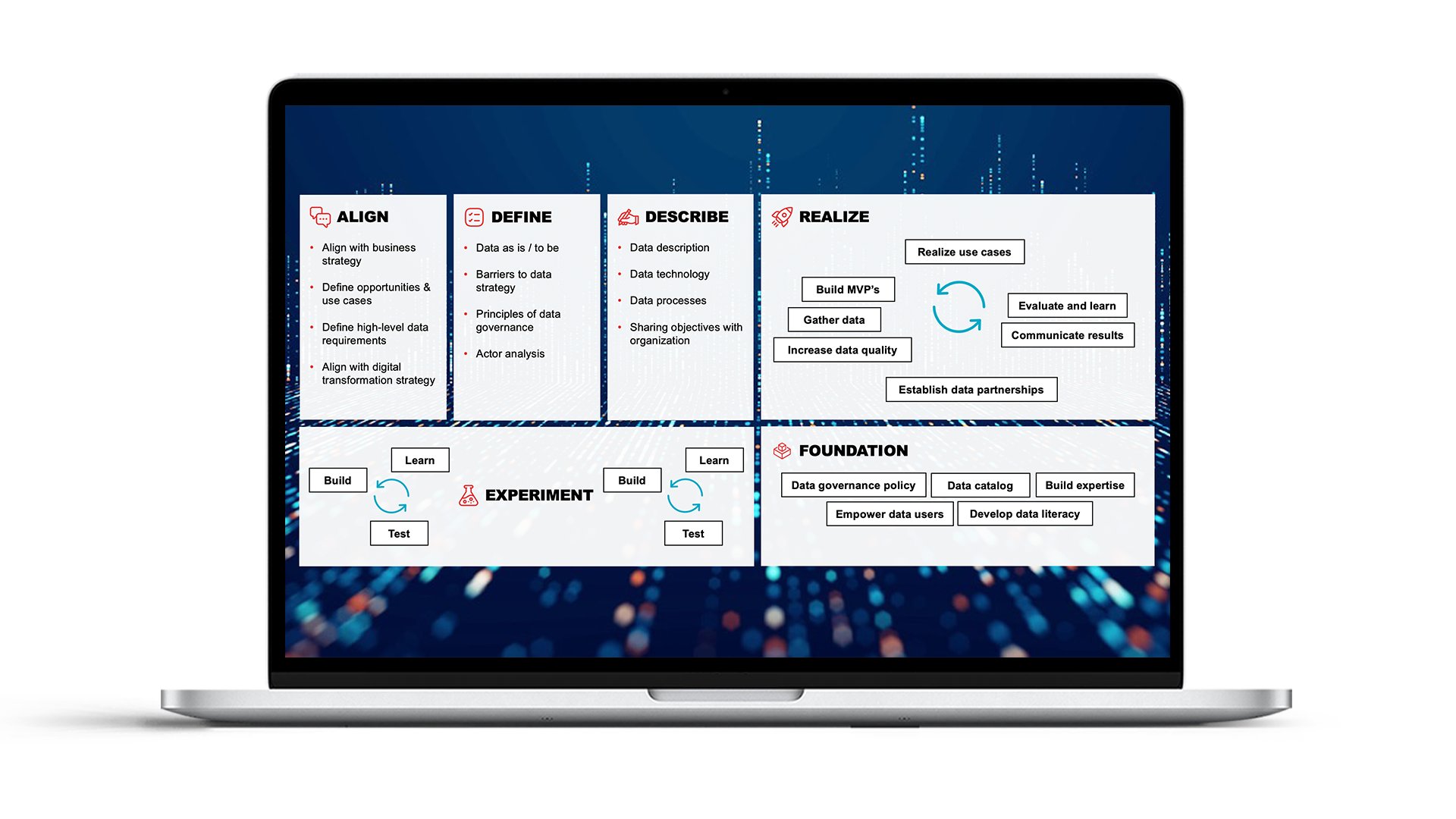
Source: Mastering Data book (“Data the Baas” or “Datenkompetenz für Die Unternehmensführung”), 2024
Why the Hybrid Approach Works
The hybrid approach works because it reflects how real organizations operate. Businesses need structure and control to manage risks, ensure compliance, and align with strategy. At the same time, they need flexibility to innovate, adapt, and respond to new opportunities.
Instead of trying to eliminate this tension, the hybrid approach embraces it. It creates space for experimentation, while ensuring that everything connects back to a larger structure. This makes it possible to deliver short-term impact without losing sight of long-term scalability.
Key Principles of the Hybrid Approach
In a hybrid approach, organizations do not wait for a perfect foundation before taking action. Nor do they experiment without direction. Instead, they move forward on two tracks at the same time:
- They build the foundation: defining strategy, governance, and architecture
- They create momentum: launching targeted use cases that deliver immediate value
These two tracks continuously interact with each other. Early use cases reveal what works and what is missing. The foundation evolves to support what proves necessary and valuable. Over time, this creates a cycle of learning, improvement, and scaling.
To make this approach work in practice, several principles are essential:
Moving From Ambition to Execution
Many organizations have strong data ambitions but struggle to turn them into results. The hybrid approach provides a practical way forward.
It helps organizations:
- Deliver quick wins without losing control
- Build trust in the added value of data through real use cases
- Scale successful initiatives across the business
- Balance innovation with compliance and risk management
Most importantly, it turns data from a series of experiments into a core capability of the organization. Becoming data-driven is not about choosing between control and innovation. It is about mastering both. Organizations that succeed are those that can experiment and scale at the same time. The hybrid approach offers a way to do exactly that.
The hybrid approach is not a fixed model, but a mindset that allows organizations to grow, adapt, and create lasting value from data.