



Sovereign AI: Balancing Control, Compliance, and Innovation
Artificial Intelligence is reshaping economies, governance, healthcare, industry, and more. But with its growing power comes renewed attention to who controls the data, infrastructure, models, and ultimately, which values and regulations govern AI. This is where the concept of sovereign AI becomes critical. At its core, sovereign AI means that a nation or organization can independently develop, maintain, and deploy AI systems, including their infrastructure, data, and governance, with minimal reliance on external parties.
This doesn’t necessarily imply isolation or rejection of global cooperation. Rather, it’s about ensuring control, compliance, and alignment with legal, cultural, economic, or security priorities, avoiding reliance on external providers whose infrastructure, jurisdiction, or incentives might diverge from domestic interests.
- Why Sovereign AI Is Gaining Traction
The idea of sovereign AI is drawing increasing attention: from national governments, enterprises, and public-sector institutions alike. Several major factors explain this trend:
Regulation, Compliance & Data Sovereignty
As AI becomes embedded in critical domains like finance, healthcare, or public services, regulation around data protection, privacy and AI governance becomes more stringent. Sovereign AI allows countries and organizations to ensure that data remains within jurisdictional boundaries, subject to local laws and oversight rather than foreign jurisdictions. This is particularly relevant in contexts where sensitive data must comply with regional regulation, and where cross-border data flows pose legal, privacy or compliance risks.
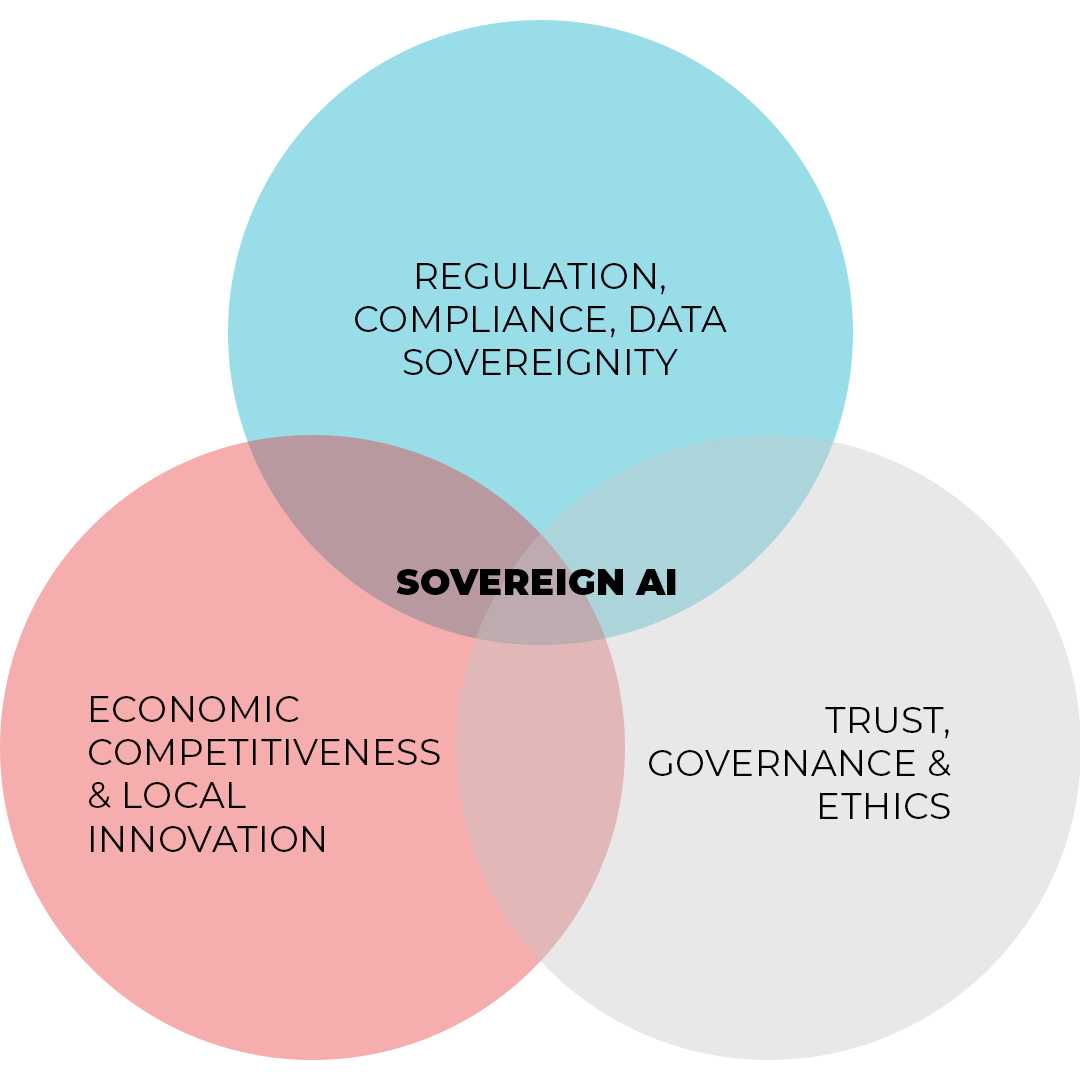
Economic Competitiveness & Local Innovation
Building a domestic AI ecosystem, combining infrastructure, talent, research and industrial capacity, promises economic growth, technological independence, and a competitive edge. Rather than simply consume global AI services, sovereign AI enables organizations to develop tailored solutions.
Trust, Governance & Ethical Alignment
Sovereign AI allows embedding ethical, legal and cultural norms into AI systems from the ground up. This includes value alignment, transparency, auditability, and adherence to societal expectations. For many governments and institutions, that alignment between AI behavior and local values/regulations is non-negotiable, especially when AI is used for public services, healthcare, or other sensitive use cases.
2. Use Cases
| Domain | Use Case |
|---|---|
|
Healthcare
|
Diagnostics, patient data analytics, genomics |
|
Public sector/Government
|
Citizen services, digital identity, public administration |
|
Finance/Banking
|
Risk modeling, fraud detection, compliance AI |
|
Industrial/Manufacturing
|
Predictive maintenance, supply-chain optimization |
|
Defense/Security
|
Secure communications, national security applications |
|
Enterprise/Corporate IT
|
Internal AI tools, policy-aware AI control planes |
3. Challenges
4. Sovereign AI in Practice
Sovereign AI is no longer just a theoretical concept; many organizations are actively implementing it. Key developments include:
Enterprise adoption of “Sovereign AI control planes”: Firms with multi-region operations or regulatory obligations use control planes to manage where data lives, which models can access it, and under what policies and jurisdictions.
Hybrid approaches combining sovereignty and interoperability: Companies often combine local data control with access to global AI models and open-source frameworks to balance compliance and innovation.
Sovereignty as a competitive advantage: Beyond compliance, organizations see sovereign AI as a strategic tool to build trust, resilience, and long-term advantage in complex regulatory and geopolitical environments.
These trends show that sovereign AI is moving from a niche compliance measure to a strategic component of enterprise AI infrastructure, shaping how companies manage data, models, and AI governance.
5. Outlook
Looking ahead, sovereign AI is becoming increasingly relevant for organizations, but it will likely take a hybrid form rather than full isolation.
Sovereignty as a continuum: Companies will aim for a balance, ensuring local control over sensitive data and compliance, while still leveraging global AI models and open-source innovation.
Growth of enterprise-focused AI ecosystems: Organizations may adopt local or regional AI platforms, sovereign clouds, and internal talent development to reduce reliance on external providers.
Adoption in regulated sectors: Enterprises in healthcare, finance, manufacturing, and critical infrastructure will continue implementing sovereign AI to meet data-residency, privacy, and compliance requirements.
Balancing autonomy and collaboration: Firms must carefully manage internal sovereignty while maintaining collaboration across regions and with external partners to avoid operational silos.
Ethical and culturally aligned AI: Sovereign AI gives companies the chance to embed local legal, ethical, and cultural norms into AI systems, increasing trust and social acceptability.
Conclusion
For companies, sovereign AI is a strategic asset and a competitive differentiator. By controlling data, infrastructure, and AI governance, organizations can achieve autonomy, trust, compliance, and innovation, while protecting sensitive assets and meeting regulatory demands.
The most effective approach for enterprises is hybrid: maintain sovereignty where it matters, but leverage global collaboration, open-source frameworks, and shared innovation where possible.
For companies in regulated industries or handling sensitive data, adopting sovereign AI is becoming a strategic imperative for resilience, competitiveness, and sustainable growth in the AI era.